

In this article
- How cats clean themselves
- The cat tongue, up close
- The grooming routine, in order
- Why do cats clean themselves so much?
- How often do cats clean themselves?
- Are cats clean animals?
- Grooming, dander, and cat allergies
- Why some cats can't keep up
- When grooming goes wrong: overgrooming and undergrooming
- What your cat still needs from you
How cats clean themselves
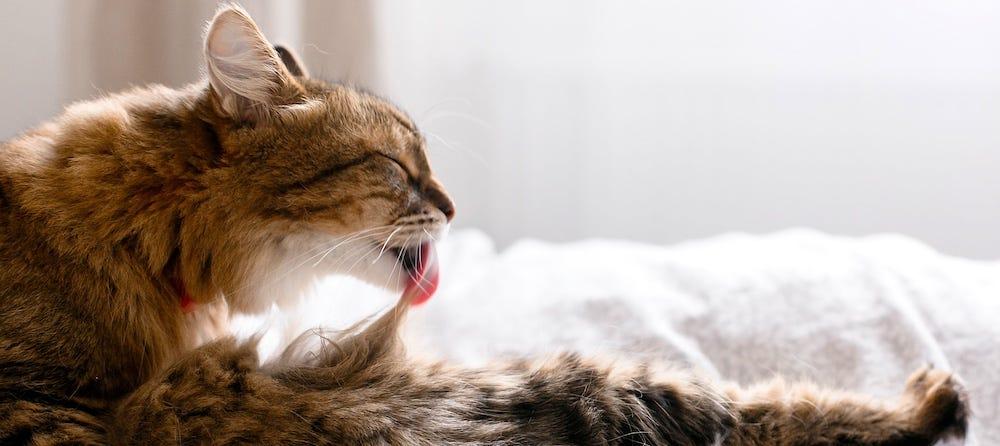
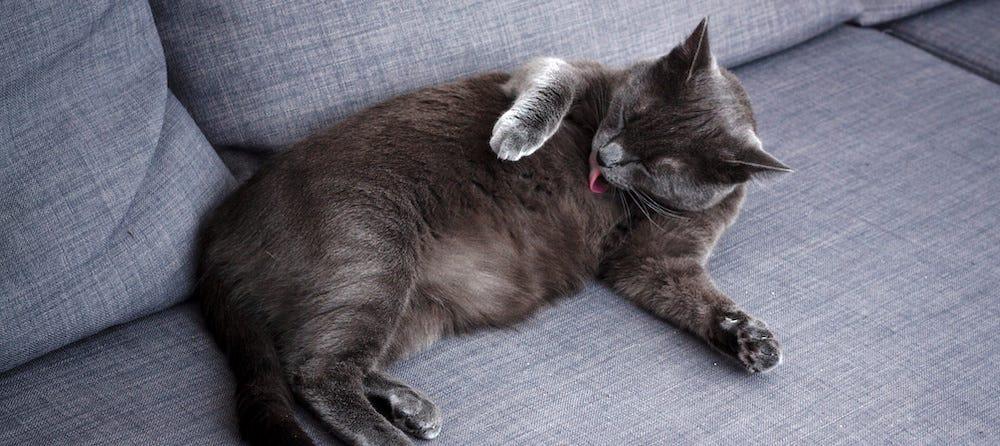
Cats clean themselves using four built-in grooming tools: their tongue, teeth, paws, and saliva. A cat’s backward-facing tongue spines comb through its fur while saliva helps loosen dirt and cool the skin. Cats also use their paws to wash hard-to-reach areas and their teeth to remove debris, working in a familiar head-to-tail grooming routine.
Self-grooming does more than keep a cat looking tidy. It helps maintain the coat, regulate body temperature, remove loose hair and debris, manage scent, and can provide a form of self-soothing.
The cat tongue, up close
A cat’s tongue is probably the most impressive part of its grooming toolkit. It’s covered with hundreds of tiny, backward-facing, keratin structures called filiform papillae. These spines catch loose fur and debris as the tongue moves through the coat.
But calling a cat’s tongue “sandpaper” doesn’t quite tell the whole story.
Researchers at the Georgia Institute of Technology used high-speed video and CT scans to study cat tongues and found that the papillae have a surprising feature: hollow, scoop-like tips. These cavities wick saliva from the cat’s mouth and release it deeper into the fur, closer to the skin. The researchers found this structure across six feline species, from domestic cats to lions.
That matters because a cat’s coat has multiple layers. The papillae are long enough to reach through the fur rather than simply wetting the surface. As saliva evaporates, it also helps cool the cat. In the Georgia Tech study, researchers estimated that saliva evaporation from grooming could account for a meaningful portion of a cat’s cooling needs.
The same grooming system has a downside, though. Cats swallow some of the loose hair they pull from their coats, which can collect into hairballs. Long-haired cats are at greater risk because they can swallow more hair during grooming.
And because cats may investigate or groom anything that gets onto their coat, keeping string, ribbon, thread, and similar materials away from them is especially important. Swallowed string can become a serious gastrointestinal problem.
The grooming routine, in order
Cats don't randomly lick wherever they happen to notice dirt. Their grooming has a fairly organized pattern that generally moves from the head toward the rest of the body. Research on feline grooming has documented this head-to-tail, or cephalocaudal, sequence.
A typical grooming session may look something like this:
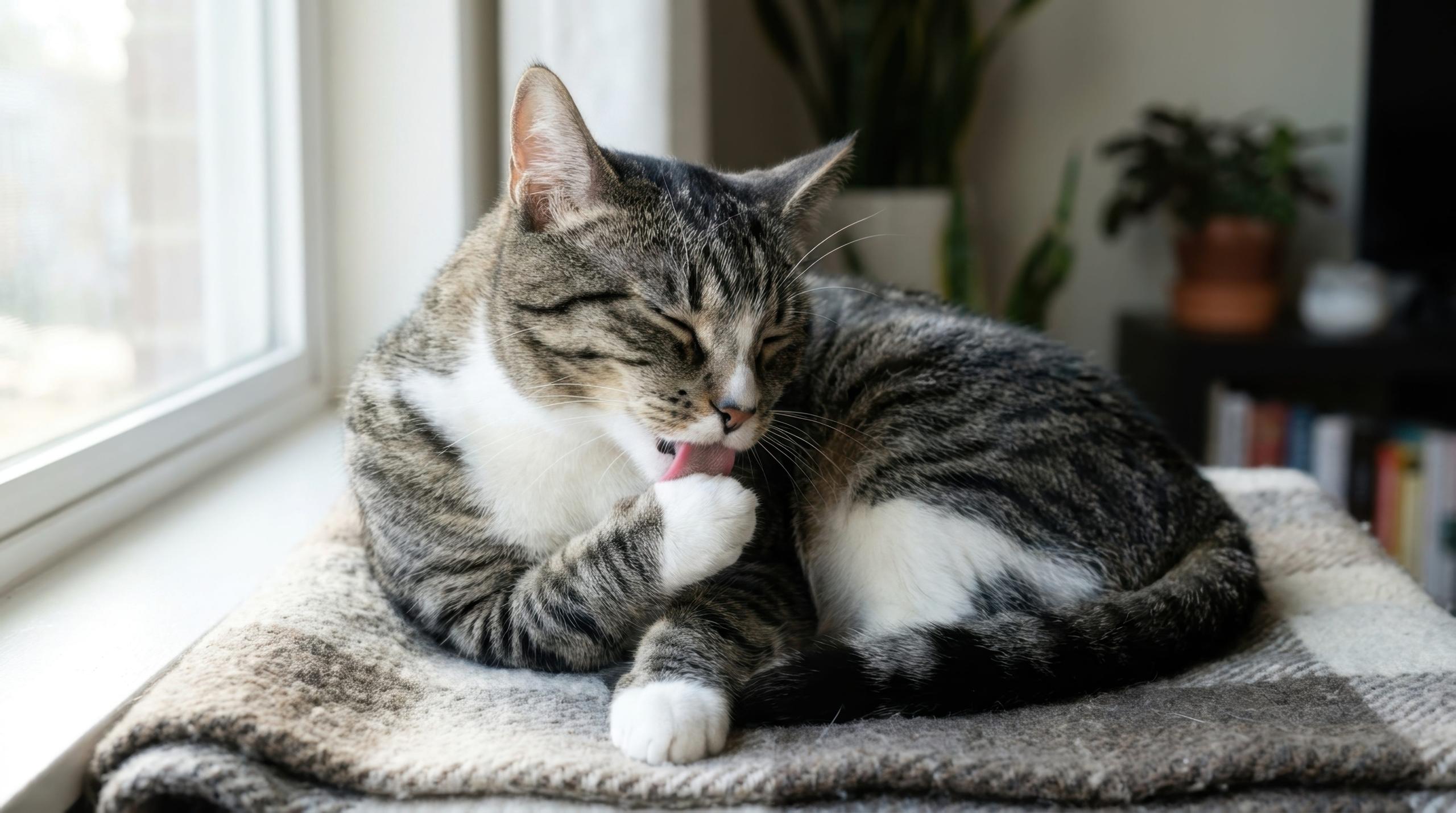
- The cat licks a paw
- The damp paw washes the face and ears
- The tongue moves over the shoulders, chest, sides, and back
- The cat twists to reach the belly, hindquarters, and legs
- The tail gets cleaned, often toward the end of the session
The paw step solves a simple engineering problem: a cat's tongue can't easily reach every part of its face. The front paw acts like a washcloth, carrying saliva to areas the tongue can't reach directly.
Cats are remarkably flexible, too. Their loose skin, mobile spine, flexible joints, and long tongue allow them to reach much of their body without help.
That doesn't mean they can reach everything. The middle of the back, the base of the tail, and other areas can become difficult to groom if a cat is overweight, arthritic, ill, or dealing with a particularly dense or long coat.
Kittens start experimenting with self-grooming at around 4 weeks of age and learn the behaviour partly by watching and interacting with their mother.
Why do cats clean themselves so much?
Cats groom for several reasons, and staying clean is only one of them.
Temperature regulation – Cats don't sweat across most of their bodies the way people do. Their paws contain sweat glands, but grooming provides another way to cool down. Saliva deposited into the fur evaporates and carries heat away from the skin.
Coat maintenance – Grooming removes loose fur, dirt, and other debris while distributing natural oils through the coat. Regular grooming also helps keep loose hair from tangling into mats.
Scent control – Cats are scent-conscious animals. Grooming can help remove smells from their fur, including the smell of food after eating. So if you've ever wondered, “Why does my cat clean itself after eating?” scent management is part of the answer.
The same idea explains another common behaviour: Why does my cat lick itself after I pet it? Your cat may simply be restoring its own familiar scent after picking up yours from being handled. It's not necessarily a sign that your cat dislikes the attention.
Wound and parasite care – Licking can help remove debris and some parasites from the coat. However, a cat repeatedly licking one particular area can be a sign that something is wrong rather than evidence that they're simply being thorough.
Self-soothing – Grooming is also a normal calming behaviour. A cat may start washing after a startling event or awkward interaction as a way to redirect itself into a familiar behaviour. Stress and anxiety can also contribute to excessive grooming, although medical causes should be ruled out first.
How often do cats clean themselves?
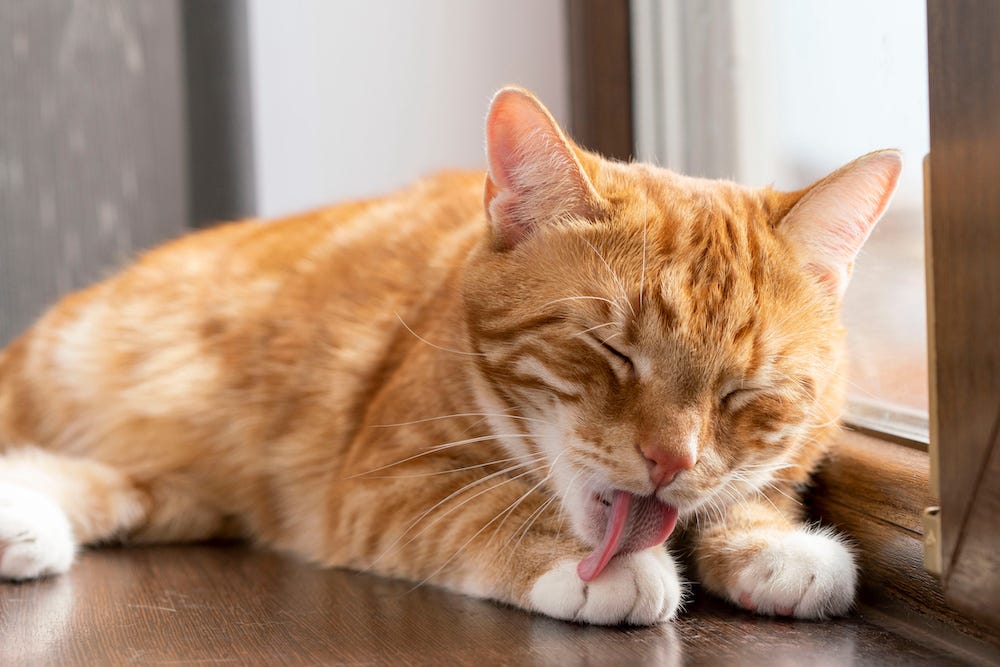
Cats spend a surprisingly large portion of their day grooming. Estimates vary depending on the study and how grooming is measured, but roughly 30 to 50% of a cat's day may be spent grooming, according to Cornell University College of Veterinary Medicine. Other research has found lower averages, with grooming making up about one-quarter to one-third of a cat's waking time.
You may notice grooming:
- After eating
- After waking up
- After being handled
- After using the litter box
- Before settling down for a nap
- After an exciting or stressful event
Age, coat type, body condition, and lifestyle can all affect grooming habits. A long-haired cat may spend more time dealing with its coat, while an older cat with arthritis may groom less because twisting and reaching have become uncomfortable.
The important thing isn't counting every lick. It's knowing what's normal for your individual cat. A sudden change in grooming frequency, especially when accompanied by hair loss, mats, flaky skin, or a dull coat, deserves attention.
Are cats clean animals?
Yes, with an important caveat.
Cats are meticulous groomers, and their grooming does a good job of removing loose hair, dirt, and debris. Their litter box habits and instinct to bury waste also help with their reputation for being tidy.
But clean isn't the same as sterile.
A cat's coat can still collect dust, pollen, litter particles, fecal material, and other substances. Grooming doesn't make these things disappear; some are swallowed, while others are redistributed throughout the coat.
And because saliva is part of the cleaning process, self-grooming isn't the same as washing with water and removing everything from the coat. That's one reason regular brushing and occasional hands-on grooming still matter.
|
Task |
Does self-grooming cover it? |
What you still need to do |
|
Remove loose fur |
Yes, partially |
Brush as needed, especially long-haired cats |
|
Remove everyday dirt and debris |
Yes, partially |
Brush or wipe the coat when necessary |
|
Distribute natural skin oils |
Yes |
Usually nothing extra |
|
Prevent all mats |
No |
Brush regularly and monitor problem areas |
|
Clean teeth |
No |
Provide regular dental care and veterinary dental exams |
|
Trim nails |
No |
Trim nails or have a professional do it |
|
Clean ears |
No |
Check ears and follow veterinary guidance |
|
Clean eye discharge |
No |
Gently wipe when needed and see a vet for persistent discharge |
|
Remove harmful substances from the coat |
Not reliably |
Prevent licking and contact a veterinarian or poison-control resource when appropriate |
Compared with many dogs, cats generally do more of their own routine coat maintenance. But even the most fastidious cat still needs some help from their people.
Grooming, dander, and cat allergies
Here's where the idea of a “clean” cat can get misleading.
The major cat allergen, Fel d 1, is produced by cats and is found in saliva and skin secretions. Because cats groom themselves, saliva and the proteins it contains are spread across their fur. Allergens can then become airborne or collect on furniture, clothing, bedding, and other surfaces.
That means a cat that grooms constantly isn't necessarily a better choice for someone with allergies. In fact, grooming is one of the ways allergens get distributed around the coat and home.
There's also no truly hypoallergenic cat. Some people may react less to certain individual cats or breeds, but no cat is completely allergy-free.
If someone in your household has cat allergies, practical steps can include:
- Brushing the cat regularly, ideally by someone who isn't allergic
- Using effective air filtration
- Cleaning hard surfaces regularly
- Washing bedding and other washable fabrics
- Keeping the cat out of allergy-sensitive areas such as the bedroom
- Reducing dust from the litter area
Brushing can help remove loose fur and reduce some allergen-containing material before it spreads through the home, but it doesn't eliminate the source of the allergen.
Why some cats can't keep up
Self-grooming works remarkably well, until something gets in the way.
Senior cats may struggle with grooming because arthritis or other mobility problems make it painful to twist, bend, or reach the hindquarters. A cat that suddenly develops a greasy or matted rear coat may be having trouble reaching it rather than simply becoming “messy.”
Overweight cats can have a similar problem. Extra body weight can make certain positions difficult, leaving areas along the lower back, belly, or tail base less thoroughly groomed.
Long-haired cats may also need regular brushing because their coats can mat faster than they can maintain them. Large mats can be painful and can contribute to skin problems.
Illness and pain can change grooming, too. Dental pain is particularly easy to miss because grooming requires repeated tongue and mouth movements. Recent feline dental-care guidelines note that a poor haircoat can be associated with decreased grooming and may be a sign of oral pain.
Some breeds have additional grooming challenges. Flat-faced cats may have difficulty cleaning around their face, while hairless cats have little or no coat to groom but can still accumulate skin oils and debris.
A matted or greasy patch in a place your cat can't reach isn't a hygiene failure. It's a clue that something may be physically preventing normal grooming.
When grooming goes wrong: overgrooming and undergrooming
Because grooming is such a normal part of feline behaviour, changes in it can be easy to overlook.
Too much grooming can lead to broken hairs, bald patches, irritated skin, or even open sores. Common areas for self-inflicted hair loss include the belly, inner legs, flanks, and other places a cat can easily reach.
Allergies, parasites, skin disease, and pain can all cause excessive grooming. Stress can play a role, too, but it shouldn't automatically be the first explanation.
Too little grooming can leave the coat dull, greasy, flaky, or matted. In an older cat, this may point to arthritis or another mobility problem. In any cat, a sudden change can also be associated with illness or pain.
Fixating on one spot is another reason to pay attention. Repeatedly licking, biting, or chewing the same area can indicate irritation or pain underneath the coat. Vet sources recommend ruling out medical causes before assuming excessive grooming is purely behavioural.
And while grooming naturally leads to some swallowed hair, frequent hairballs or repeated vomiting shouldn't simply be written off as “normal cat behaviour.” Excessive grooming can increase the amount of hair swallowed, and repeated vomiting warrants veterinary attention.
What your cat still needs from you
Your cat may be an excellent self-groomer, but they don't have the whole job covered.
Brushing is the biggest assist. Short-haired cats may only need occasional brushing, while long-haired cats often need regular brushing to prevent mats and remove loose hair before they swallow it.
There are also several jobs a cat's tongue can't handle:
- Nails: Cats can't trim their own claws to a healthy length.
- Teeth: Self-grooming doesn't replace dental care.
- Ears: Cats can maintain much of their ear hygiene themselves, but persistent wax, discharge, odour, or irritation needs veterinary attention.
- Eyes: Normal eye discharge can sometimes be gently wiped away, but ongoing or excessive discharge should be checked.
- Severe mats or contaminated fur: These may require a professional groomer or vet.
Most healthy cats don't need routine baths. Their normal grooming does a good job of maintaining the coat. A bath might be necessary if a cat gets into something particularly dirty or potentially harmful, or if a vet recommends bathing for a medical condition.
A weekly once-over is a simple way to catch changes early. Run your hands through your cat's coat and look for mats, dandruff, bald spots, redness, skin changes, or areas that suddenly look different from the rest of the body. Routine grooming can also give you a chance to notice changes that might otherwise be easy to miss.
If your cat suddenly stops grooming, starts grooming one area obsessively, develops bald patches or skin injuries, or can no longer keep their coat clean, don't assume they just need more brushing. Start by looking for the reason behind the grooming change. A vet can help determine whether pain, skin disease, parasites, dental problems, mobility issues, or another health problem is involved.