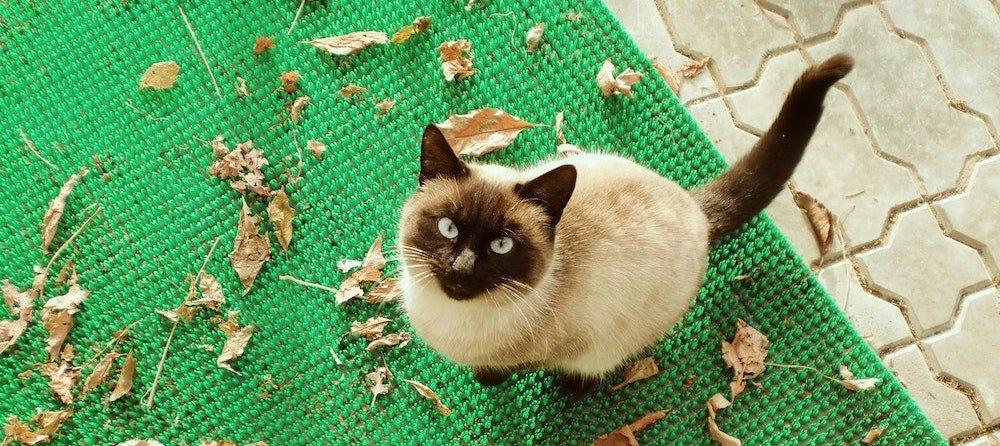

Colour us impressed with these colourpoint cat breeds! Did you know that colourpoint refers to many cats’ colours and patterns, as well as specific cat breeds like the Colorpoint Shorthair? Learn more about the variety of colours and patterns you’ll find on these stunning colourpoint cats.
What are colourpoint cats?
Point colouration in cats happens when the coat presents colour only on the face, feet, and tail, also known as “points” or “point cats.” This colouration is due to a form of partial albinism resulting from a mutation of the enzyme responsible for melanin production, the tyrosinase. Both parents must carry the colourpoint gene to produce a colourpoint kitten.
Colourpoint is a pattern… and a breed!
Like tabby, calico, tortie, and tuxedo, colourpoint refers to a coat pattern. Unlike those other patterns, colourpoint can also refer to a breed!
As a pattern, colourpoint is most commonly associated with Siamese cats.
As a breed, colourpoint is most commonly associated with Colorpoint Shorthair cats.
Dozens of colourpoint varieties

While Siamese cats are formally recognised in only four colours (seal, chocolate, blue, and lilac), colourpoint cats can display dozens of colour and pattern combinations.
Colours:
- Seal point (dark brown point)
- Cream point
- Red point (also called flame point)
- Cinnamon point
- Fawn point
- Chocolate point
- Blue point
- Lilac point
- Caramel point
- Apricot point
Patterns:
- Solid point (in any of the colours)
- Lynx (tabby) point (in any of the colours)
- Tortie point (in any of the colours)
- Tortie-lynx point (in any of the colours)
8 colourpoint cat breeds
Siamese

The most recognised colourpoint cat is undoubtedly the Siamese. The Cat Fanciers’ Association recognises the four original Siamese colours for cat show contestants: blue point, lilac point, chocolate point, and, the most common, the seal point cat. However, Siamese cats can “unofficially” display 32 coat colours and patterns! These include lynx (tabby) points with the traditional tabby “M” marked on their forehead, as well as tortie points with the lovely tortoiseshell pattern.
The Siamese is an ancient natural breed with a storied history. These cats have been companions to ancient temple priests, revered patrons of royal families, and contributors to countless modern feline pedigrees. They have a loud, low-pitched voice that could be compared to the cries of a human baby. The Siamese is quick to befriend anyone who walks in the door, chatting them up as if they were already the best of pals.
Colorpoint Shorthair

The Colorpoint Shorthair is a cross between a Siamese and a red American Shorthair. They were developed by breeders wanting to expand on the traditional Siamese colours, specifically a red cat that maintained most of the Siamese features. Red and cream Colorpoint Shorthairs were first accepted for championship status by the Cat Fanciers’ Association in the 1960s, and soon other colours followed.
Today this breed comes in 16 non-traditional colours: These include red, cream, seal, chocolate, blue, and lilac colours, as well as solid, lynx, and tortie patterns. Although typically small in stature, they are known for a big, raspy voice.
Like their parent breed the Siamese, the Colorpoint Shorthair is a very talkative, intelligent cat. Like the American Shorthair, however, they sometimes need a little bit of time to warm up to strangers. They will follow their humans around and don’t like being left alone for too long. Sometimes these cats do better when paired with another cat or dog in the home.
Birman

Like the Siamese, the Birman is a natural colourpoint cat; it's said that this breed originated in the temples of Burma. Legend has it that this beautiful, semi-longhaired cat acquired their coloured points, white paws, and deep sapphire gaze from a blue-eyed goddess.
The Birman’s coat pattern and colourings tend to resemble a mix between a Siamese and Ragdoll cat. Like the Siamese, they have four main coat colours: seal point, blue point, chocolate point, and lilac point. However, some cat associations and councils will accept other colours, including red, cream, and tortie. They are well known for their “gloves and laces” patterns.
This is a docile cat breed that loves being held. They are typically quiet (unlike their Siamese cousins) and make a great companion looking for a laid-back lifestyle.
Tonkinese

The Tonkinese breed resulted from pairings between Siamese and Burmese cats. The Tonkinese comes in natural, champagne, blue, and platinum colours and solid, mink, and pointed patterns. These cats don’t always develop a full body of colour until up to 16 months of age. Even then, their colouring will become darker as they age. They’re also the first pedigreed cat with an aqua eye colour!
Like the Burmese, Tonkinese cats love to play and interact with their family members—so being in a sociable home where someone is able and willing to do this is essential. And like the Siamese, Tonkinese cats are vocal and will have many conversations with you throughout the day.
Balinese
The long-haired version of the Siamese cat, the Balinese breed was named after Bali dancers for their graceful yet muscular stature. Their coat is semi-long to long and silky, and usually displays as a point pattern; like the Siamese, their colours are typically recognised as lilac point, chocolate point, seal point, or blue point.
The breed originated in the 1940s after crossing Siamese cats with Domestic Longhair cats. Some cat associations consider the Balinese to be a separate breed from the Siamese, while others consider them to be the long-haired version of the same breed.
As far as long-haired cats go, the Balinese isn’t rather demanding: They do not have an undercoat, which makes shedding light and grooming easier. However, they are socially demanding cats. The breed is very vocal and loving, and requires a lot of attention.
Himalayan

Another long-haired colourpoint cat, the Himalayan was developed by crossing a Siamese and a Persian cat. These sweet, docile cats feature the colour and pattern of the Siamese, but the long hair and facial features of the Persian. They come in many colours and point patterns: seal, chocolate, lilac, blue, red, cream, tortie, lynx, and combinations thereof.
You’ll have to spend a lot of time grooming a Himalayan: Their hair is very fine and silky, which leads to matting and tangling. These cats prefer quiet, serene homes and lots of love. They are playful with their humans, but not generally energetic. They are very devoted to their families, and may get bored or lonely if they feel they aren’t getting enough attention.
Ragdoll

The Ragdoll cat is one of the largest and gentlest cat breeds, even known to collapse in the arms of anyone who holds them. Besides their size and temperament, they’re known for their long, silky coats and variety of colour points and patterns. Their cousin, the Ragamuffin, comes in even more colours and patterns!
In addition to standard colourpoint, the Ragdoll can display mitted, bicolour, lynx point, and tortie point patterns. Mitted is similar to colourpoint, except with white feet that give off the appearance of mittens. The bicolour Ragdoll pattern displays a lighter stomach and paws with an inverted “V” colouring pattern on their faces. The lynx point presents tabby markings on their face that will sometimes look like a “W.” And a tortie point features overlays of red and cream in the colouring.
Snowshoe

The Snowshoe cat breed was developed in the 1960s with the aim of combining Siamese points with the white feet of a Birman cat. Typically, the Snowshoe cat will come in shades like chocolate, fawn, and blue, but other colours like black, orange, and lilac are possible. All Snowshoe cats have white paws, but how far the white extends up their legs can vary.
Interestingly, Snowshoe kittens are born totally white. Their point colouring starts to develop a few weeks after birth. All Snowshoe cats should have an upside-down “V” that arches over their nose, almost giving them the appearance of wearing a mask.
This uncommon breed is smart, active, and happiest in family settings, although they tend to have one “favourite” person. Because they get along well with so many different types of animals and people, they thrive in a multi-pet household where they can have a few companions.
Of course, this is just a sample of colourpoint cats and their associated breeds. All colourpoint cats are special felines, indeed!
Photo credits:
- Cover photo: Ilja Frei via Unsplash
- Colorpoint Shorthair: Marieke Tacken via Unsplash