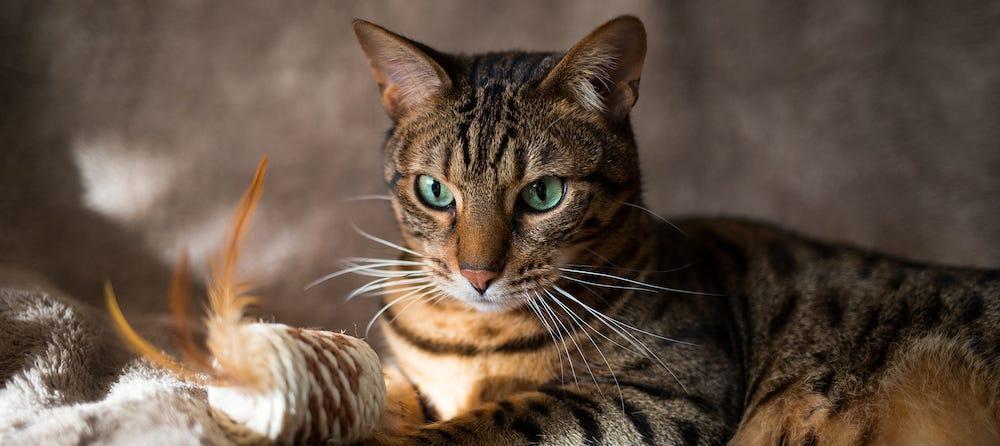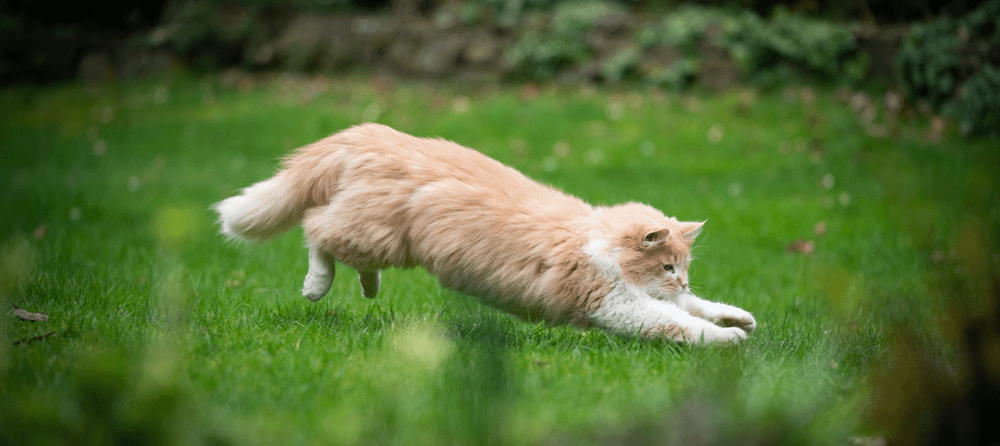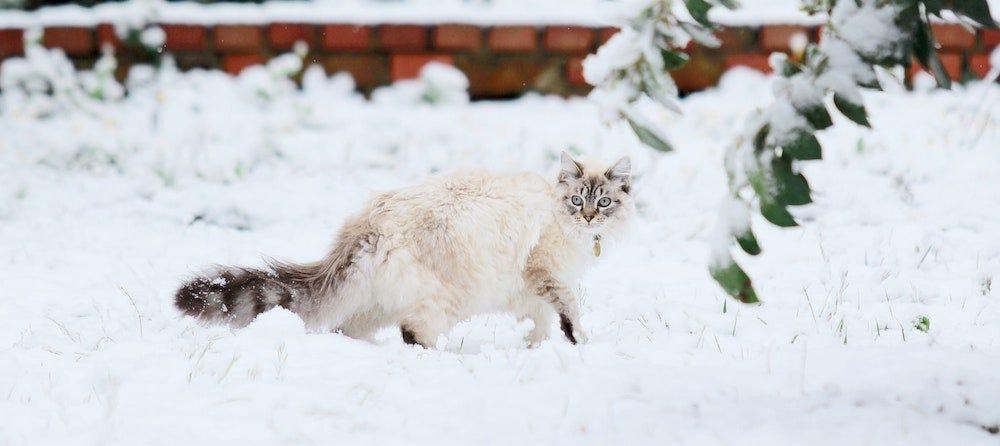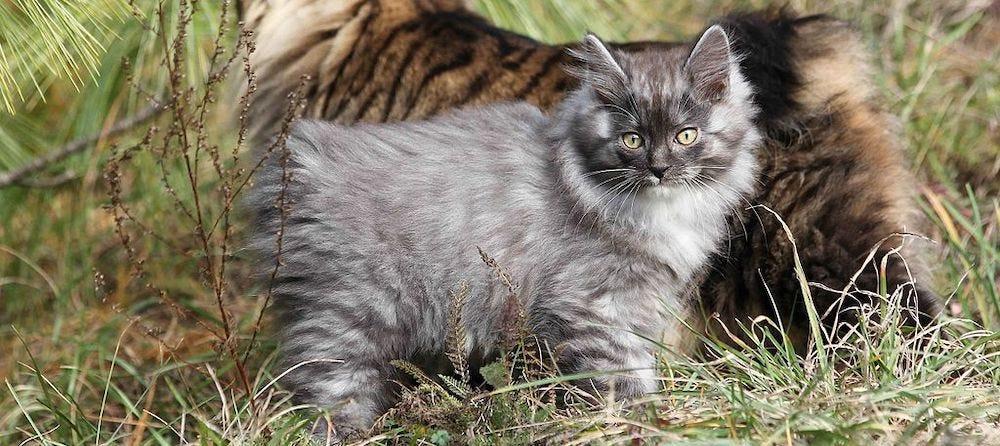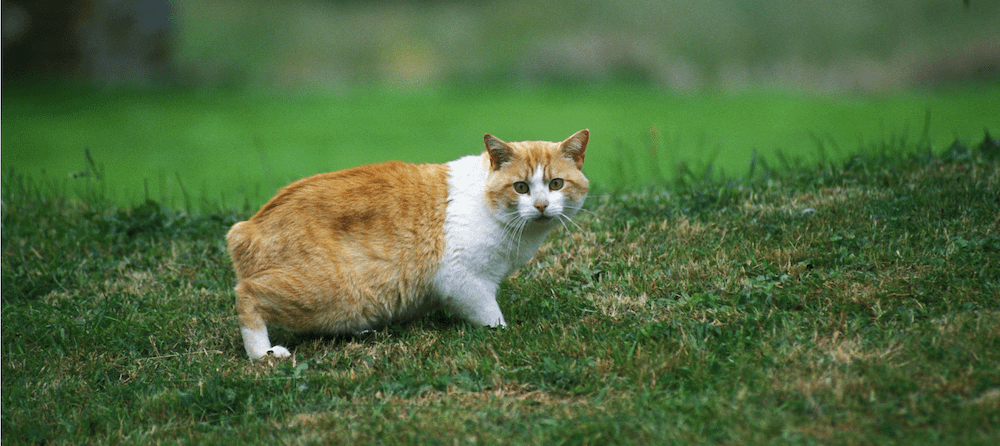
The Manx cat is famous for their outgoing personality and tailless body. They are a unique breed of cat that appears small because of the lack of a tail, but will surprise you with their actual size.
The Manx is a rather plush-looking cat breed that instantly captures your heart. They are a friendly cat breed that gets along with everyone they meet and doesn’t show much apprehension towards strangers. They receive a lot of attention due to their lack of tail, but that doesn’t bother them one bit. Manx cats actually prefer the attention!
If you are looking to adopt a Manx cat, you should learn more about the controversy and possible health problems surrounding this breed. Please adopt a Manx cat rather than buy from a breeder.
| Manx cat | ...at a glance |
|---|---|
| Personality | Easygoing, intelligent, playful |
| Life expectancy | 8-16 years |
| Weight | 7-12 lbs |
| Coat & colors | Short or long; various colors & patterns |
| Energy level | High |
| Affection level | High |
| Friendliness | High |
| Shedding level | Medium |
| Required grooming | Medium |
Manx cat breed overview
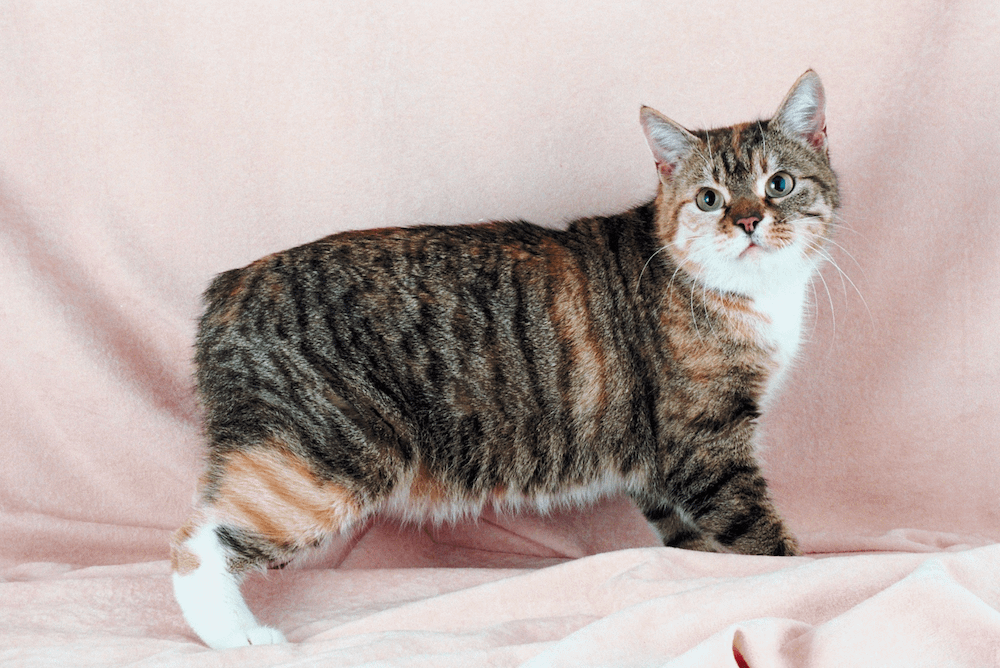
The Manx is a medium-sized cat breed most easily recognized by their lack of a tail. They have a fairly round appearance with sharply pointed ears, which contradict their overall roundness.
Typically, male Manx cats will be slightly larger than their female counterparts. How big your Manx is might surprise you, but their weight will become more apparent as soon as they climb into your lap.
Weight
The weight of a Manx might fluctuate depending on how active they are in your home. While these cats are quite playful, they are dedicated snugglers that love to cuddle with their humans. Males typically range between 8 and 12 pounds, while females are 7 to 11 pounds.
Length
Without a long tail behind them, the Manx cat reaches up to 14 inches in length from the tip of their noses to their cute little behinds. Despite their lack of tail, this still makes for a long cat. Plus, they don’t let their lack of tail set them back or make them feel small.
Coat
Manx cats can have either short or long coats, but the shorter variation is more common. Their coats are plush and dense, only adding to the roundness of this breed.
Their coats can come in a variety of colors, including white, blue (grey), black, red (orange), cream, brown, and silver.
Additionally, they can display many coat patterns, including bicolor, calico, tabby, tortoiseshell, and solid. Orange, tabby, and tortoiseshell Manx cats are the most common, while solid white or colorpoint Manxes are quite rare.
Lifespan
One of the biggest concerns for this breed is Manx Syndrome, linked to the tailless gene, which can reduce the Manx cat’s lifespan. Tailless Manx cats all carry these genes, but not all will express the condition. It’s important to note that Manx kittens from the same litter will not all have the same tail. In one litter, you could have cats with normal-length tails as well as shorter tail variations.
Manx cats that don’t suffer from Manx Syndrome have a lifespan of 8 to 16 years. To ensure your Manx lives as long as possible, make sure you’re taking them to yearly check-ups at the vet.
Manx Cats: FAQ
Q: Why don't Manx cats have tails, and what does it mean for their health?
A: The most widely accepted explanation is that the Manx cat's taillessness is due to a natural genetic mutation. This dominant gene affects spinal development, leading to a shortened or absent tail. This mutation became prevalent on the Isle of Man, their isolated island origin, due to a limited gene pool. While many Manx cats are perfectly healthy, this gene can sometimes lead to Manx Syndrome, a serious condition causing spinal abnormalities that affect nerves and muscles in the hindquarters, bladder, and bowels. This can impact a Manx cat's overall health and, in severe cases, even their Manx cat lifespan.
Q: Are all Manx cats completely tailless, or can they have short tails?
A: Not all Manx cats are completely tailless. While the "rumpy" (completely tailless) is the most well-known, Manx cats can be born with various tail lengths within the same litter:
- Rumpy: Completely tailless, with just a dimple where the tail would normally be.
- Rumpy Riser: Has a small bump of cartilage under the fur at the tail's base.
- Stumpy: Has a short, stubby tail, usually a few inches long.
- Longy: Has a full-length or nearly full-length tail, though this is less common.
Q: Does the lack of a tail affect a Manx cat's balance or agility?
A: Despite popular misconception, the absence of a tail generally does not significantly affect a Manx cat's balance or agility. Their strong hind legs, which are longer than their front legs, along with their robust body structure, compensate for the missing tail. This allows them to jump, climb, and maneuver with remarkable grace.
Q: I've heard people search for "minks cat" or "mynx cat." Is this correct?
A: A common mistake people make when searching for Manx cats is using terms like “minks” or “mynx.” These terms are usually typos or phonetic guesses based on how the name actually sounds! The correct spelling is Manx cat, referring to their origin on the Isle of Man.
Q: What is the typical Manx cat lifespan?
A: For Manx cats that do not suffer from Manx Syndrome, their Manx cat lifespan typically ranges from 8 to 16 years. However, like any breed, individual health, diet, and veterinary care play a significant role in how long a Manx cat will live. Cats severely affected by Manx Syndrome may have a shorter lifespan. Regular veterinary check-ups are crucial for ensuring your Manx lives a long and healthy life.
History of the Manx cat
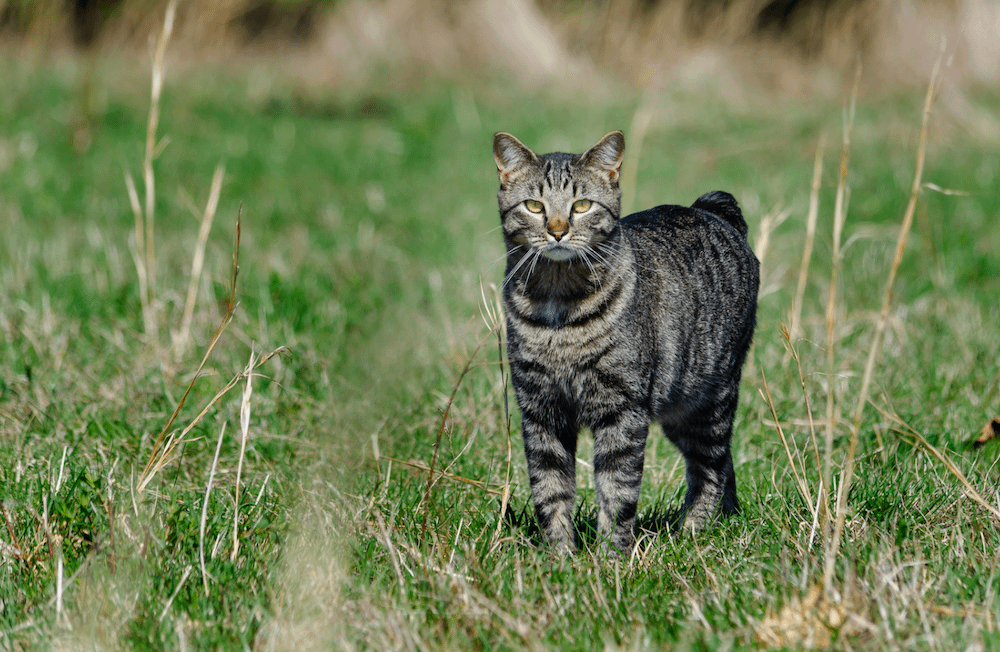
The Manx is considered a very old breed of cat that has lived naturally for centuries. They hail from the Isle of Man off the coast of Britain in the Irish Sea, where their population has pretty much become dominant. These local cats were nicknamed “stubbing” and “rumpy.”
There are many different stories as to how this unique cat came to be. One legend tells of a Spanish Armada shipwreck that occurred off the island's coast, resulting in a few Manx cats swimming to shore. When these cats with shortened tails began to repopulate, the genetic mutation became dominant due to the island's inherent isolation.
Another tall tale told about the Manx cat is that they were running to board Noah’s Ark when Noah closed the door and chopped off their tail.
Most likely, the Manx cat originated due to a spontaneous mutation that resulted in short tails that either Nordic or Spanish sailors introduced. Due to the isolation of the island, this mutation soon became dominant; most cats born on the island had the same distinct short tail. Without other cats to breed with, the Manx cat population flourished and became the staple of the island.
Shorthair versus longhair
The Manx was one of the first cats to wow admirers in the circuit in Great Britain. The Manx breed was recognized by the Cat Fanciers Association (CFA) in 1906. However, not every cat registry classifies the breed in the same way. We can’t talk about the Manx without talking about the Cymric cat.
The Cymric cat has four tail types with a silky medium coat length. The Cat Fanciers’ Association (CFA) judges them as part of the shorthair category of the Manx breed. The International Cat Association (TICA) views the Cymric as a separate breed. TICA evaluates this cat in the long-haired show group.
Manx cat characteristics
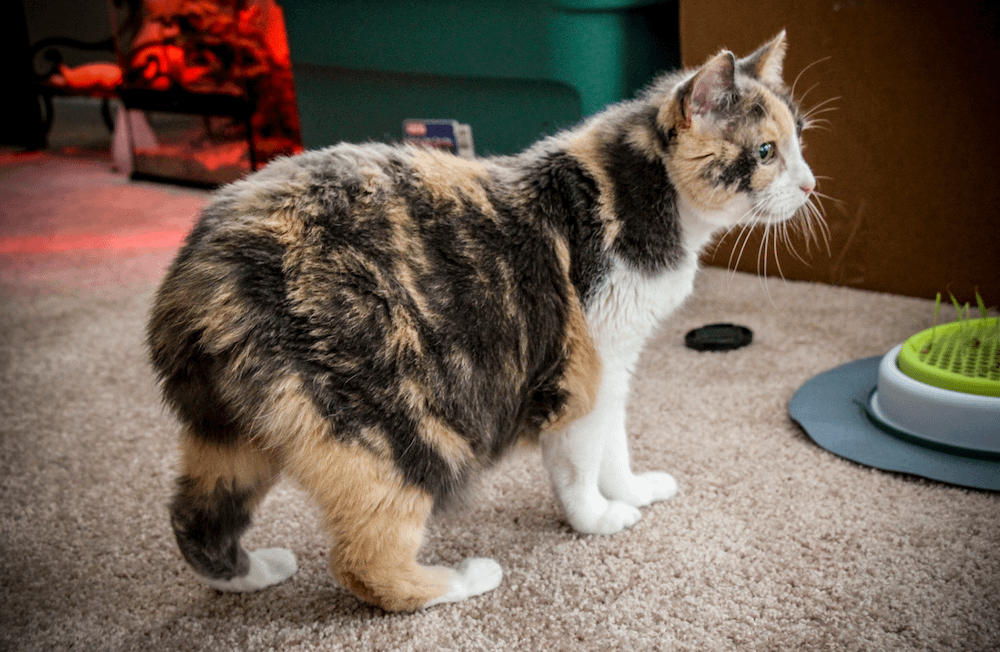
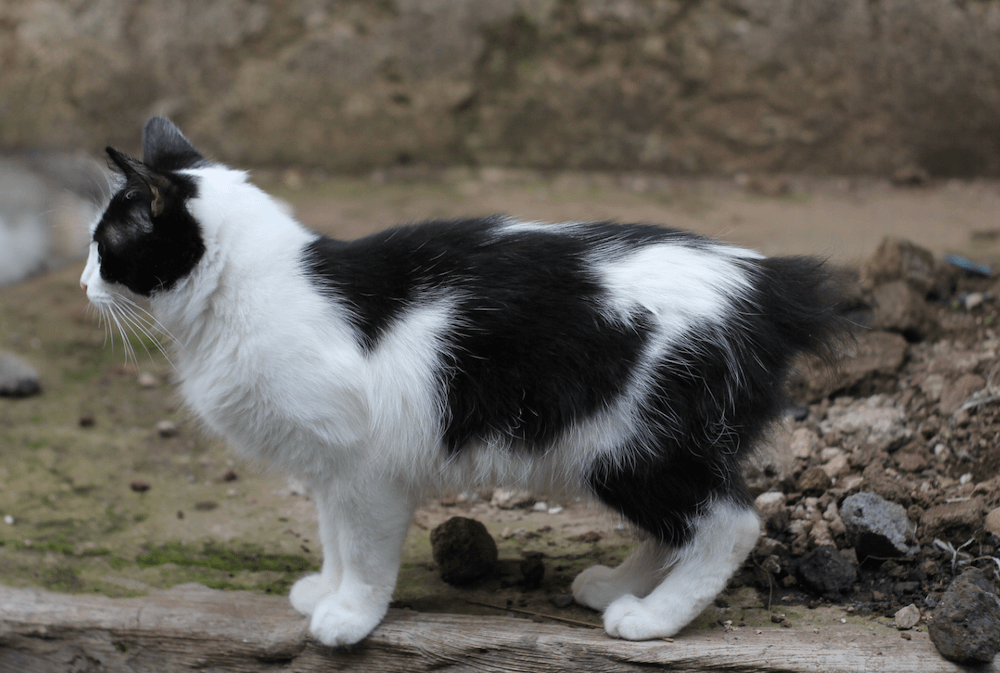
Manx cats without tails are usually referred to as “rumpy,” while Manx cats with short stubby tails are known as “rumpy risers.”
A Manx cat with a partial tail, usually only an inch long, is called a “stumpy,” and a Manx with a half-tail is called “stubby.” A Manx with a full-length tail is called a “longy.” These might not be the most scientific names, but they sure do explain what you’re looking at!
Manx cats are medium in size and quite stocky. They are remarkably round cats: round bodies, round paws, round heads, and round eyes. Eye colors range widely, including gold, copper, blue, green, hazel, and odd-eyed.
Their ears are on the smaller side but come to a point that offsets the rest of their roundness. Their hind legs are longer than their front legs, giving them the appearance of an arched back.
Thanks to their thick coats, Manx cats tend to thrive in colder weather and water more easily than some other cat breeds.
Personality and behavior
The Manx is a first-rate hunter. They will track down any vermin that comes into your house, mice and insects alike, and they’ll do it with endless joy! Their first jobs on ships were to catch mice and help with pest control, so if you have an issue with this in your home, the Manx has you covered.
Other than being adept hunters, they are also wonderful family pets. They are loyal and affectionate toward their humans and accepting of strangers. They love to curl up next to you on the couch at night but don’t mind when you spend one-on-one time training or entertaining them. They are highly intelligent and can learn many tricks as long as a few treats are involved.
They love their humans but are independent as needed. You might not always see your Manx cat, but they are likely watching you. They know what’s going on in the household at all times but don’t always make their presence known. However, don’t be surprised if your Manx decides to follow you around all day; it can be a toss-up!
Caring for a Manx cat
Manx cats are relatively easy to care for due to their independent and mellow attitudes. They aren’t going to hound you for attention, but they do benefit from togetherness.
The Manx requires a moderate to high level of activity. They need to exercise daily but usually have no problem doing it on their own, climbing up and down their cat shelves and cat trees. If you let them, they will pick up a scent and go hunting for hours.
Since they are so intelligent, Manx cats appreciate enrichment toys and puzzles that can help burn mental energy. They are a breed that can and will jump to the highest points in your house, so if you have shelves covered with knick-knacks, you might need to Manx-proof them.
Grooming
Grooming requirements for a Manx are pretty moderate. Even with their thick double coats, they don’t tend to shed as much as other similarly-coated cats.
They require brushing a few times a week to gather any loose fur, but they do a great job keeping themselves clean. Long-haired Manx cats, on the other hand, are more likely to require daily brushing. The short-haired Manx also has a double coat.
Your feline needs help to maintain proper dental hygiene to avoid periodontal disease. Be sure to trim their nails every few weeks to prevent discomfort, and consider using a self-cleaning litter box to keep your feline friend’s litter area nice and fresh.
Health-related issues
As already mentioned, Manx Syndrome is a serious medical condition that can cause severe developmental abnormalities and even death in Manx kittens and cats. If you are looking to have a Manx as a pet, be sure to adopt from a rescue group rather than perpetuate inhumane breeding practices.
Manx cats are more prone to a shortened spine that can fail to provide muscle and nerve endings, creating significant discomfort. Tailless cats are also prone to megacolon, a health problem resulting from a spinal cord injury.
Other potential health issues include weakened hindquarters, spina bifida, and arthritis.
Adopting a Manx
Bringing a Manx cat into your life fills your home with love and endless entertainment. Their unique tailless appearance captivates everyone, and these dog-like companions form deep bonds, thriving on family involvement. Their playfulness and intelligence ensure there's never a dull moment.
If you're considering adopting a Manx, here's how to find one:
- Shelters and Rescues: Manx cats occasionally appear in local shelters, but your best bet is breed-specific Manx rescue organizations. These groups are dedicated to finding homes for Manx cats and often have extensive networks. Search online for "[Your City/State] Manx cat rescue" or set up alerts on adoption platforms like Petfinder.com for the "Manx" breed.
- Ethical Breeders (Use Caution): While we strongly advocate for adoption due to potential health issues like Manx Syndrome, if you choose a breeder, ensure they prioritize health. A responsible breeder will be transparent about genetic testing, provide health guarantees, answer questions about Manx Syndrome, and allow you to meet the kitten's parents. They should also only breed "rumpy" Manx cats with "longy" or full-tailed Manx to minimize severe health risks. Reputable breeders are often found through breed associations like the CFA or TICA. Always exercise extreme caution to avoid unethical breeders.
We strongly recommend adopting a Manx cat from a rescue organization. This supports cats in need and promotes humane pet ownership, while also helping to prevent the continuation of breeding practices that could lead to health issues. You'll gain a wonderful companion and contribute to a more compassionate approach to pet adoption.
Sources:
- Multiple Mutant T Alleles Cause Haploinsufficiency Of Brachyury And Short Tails In Manx Cats | NCBI
- Periodontal Disease In Cats: Back To Basics--With An Eye On The Future | NCBI
- Tethered Cord Syndrome With Spina Bifida Aperta In Cats: Two Case Reports Of Different Types | NCBI
- Cymric (Longhaired Manx) | Animal Health Clinic
- Megacolon in Cats | VCA Animal Hospital
- Manx Syndrome | UFAW